What is IATF 16949?
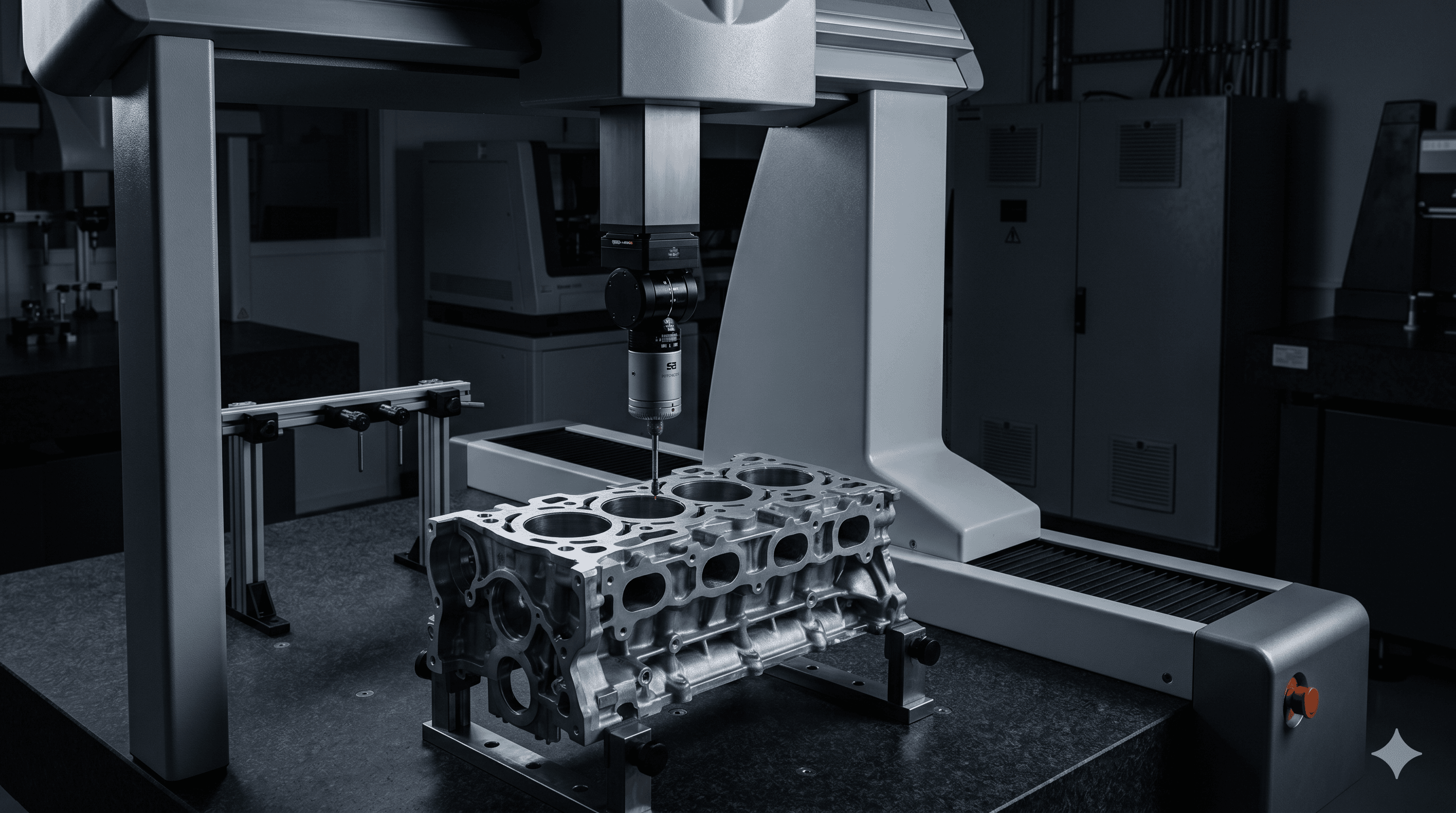

The automotive quality standard, the six Core Tools, and why your quality data matters more than your quality manual.
If you work in automotive manufacturing, you've encountered IATF 16949. It's the certification your OEM customer requires, the standard your auditor checks you against, and — if we're honest — the acronym that makes most people think of paperwork. But IATF 16949 isn't really about documentation. It's a framework designed to prevent defects from reaching your customer's customer. The documentation is just how you prove it.
What it actually is
IATF 16949 is an automotive-specific quality management standard published by the International Automotive Task Force (IATF). It's not standalone — it's a supplement to ISO 9001, the global quality management system standard. If you're certified to IATF 16949, you're also complying with ISO 9001 simultaneously.
Most major OEMs — Ford, GM, Stellantis, BMW, and others — mandate this certification as a prerequisite for their suppliers. No certification, no contracts. It's structured around the Plan-Do-Check-Act (PDCA) cycle, the same improvement loop that ISO 9001 uses, but layered with automotive-specific requirements for how you design, produce, and validate parts.
The six tools that make it work
IATF 16949 relies on a set of practical tools called the Quality Core Tools. As of March 2024, when AIAG (the Automotive Industry Action Group) split Control Plan into its own standalone manual, the canonical list expanded from five to six. Most articles online still say five — that's outdated.
| Tool | What it does |
|---|---|
| APQP | Plans quality into the product from day one — before you cut metal, you've mapped where failures could happen |
| Control Plan | Documents how each critical characteristic is monitored in production — the living document operators follow on the line |
| FMEA | Scores risks by severity, occurrence, and detection — a structured argument for where to spend prevention effort |
| MSA | Proves your measurement system can detect what you're measuring — if your gauge lies, your control charts lie too |
| SPC | Monitors process stability in real time using control charts — the early warning system that catches drift before it becomes scrap |
| PPAP | Proves to the customer you can produce parts to spec at production rate — the formal handshake before mass production begins |
A note on SPC: control charts are the standard's required method, but they're far from the only way to detect process anomalies. Modern techniques — machine learning-based anomaly detection and multivariate pattern recognition — can outperform traditional SPC many-fold, especially on high-frequency, high-dimensional data. veyra includes both: the SPC your auditor expects and the advanced detection methods your process actually needs.
The thread connecting all six tools is Special Characteristics — the dimensions, properties, and process parameters that have significant effects on safety, fit, or function. Each tool receives, refines, or validates them. APQP identifies them, FMEA scores their risk, the Control Plan documents how to monitor them, MSA validates the gauge can measure them, anomaly detection methods (like SPC) watch them in real time, and PPAP proves they're under control.
Where organizations struggle
Three patterns show up again and again in audit findings:
- Control Plans that don't match reality. The document exists, but reaction plans are vague, frequencies are arbitrary, and links to the FMEA are stale. Control Plan is consistently in the top 10 audit nonconformances tracked by the IAOB.
- MSA treated as a one-time checkbox. Gauge R&R is run at PPAP and never revisited. The measurement system drifts, and SPC conclusions become unreliable without anyone noticing.
- SPC data collected but not acted on. Control charts are maintained in spreadsheets, reviewed weekly or monthly. By the time someone sees a signal, thousands of parts have shipped.
The common thread: a gap between documented compliance and operational reality. The standard asks for both. Most organizations are better at the first than the second.
What the standard is really asking for
IATF 16949 doesn't just ask "do you have a control plan?" — it asks "does your control plan reflect what's actually happening, and can you prove it?" The same goes for SPC: not "do you collect data?" but "do you act on it in time to matter?"
The direction of the standard is clear. The 2025 IATF Rules tightened audit discipline — 15-day nonconformity response windows, stricter planning requirements, remote audits restricted. The upcoming 2027 revision will push further into data integrity and digital manufacturing controls. Real-time, auditable, connected data is becoming the baseline expectation, not the aspirational goal.
This is the space veyra occupies. We build real-time anomaly detection, MSA, and process capability tooling — designed to close the gap between what your control plan says and what your production line actually does.
But we go further. veyra also brings AI-powered root cause analysis, advanced anomaly detection that goes well beyond traditional control charts, and intelligent alerting — so you don't just know that something changed, you know why. IATF 16949 sets the floor. We help you build above it.
ISO 9001:2026 is currently in draft, and IATF 16949:2027 will follow. The next post in this series will break down exactly what the draft changes clause by clause and what it means for quality teams on the shop floor.